
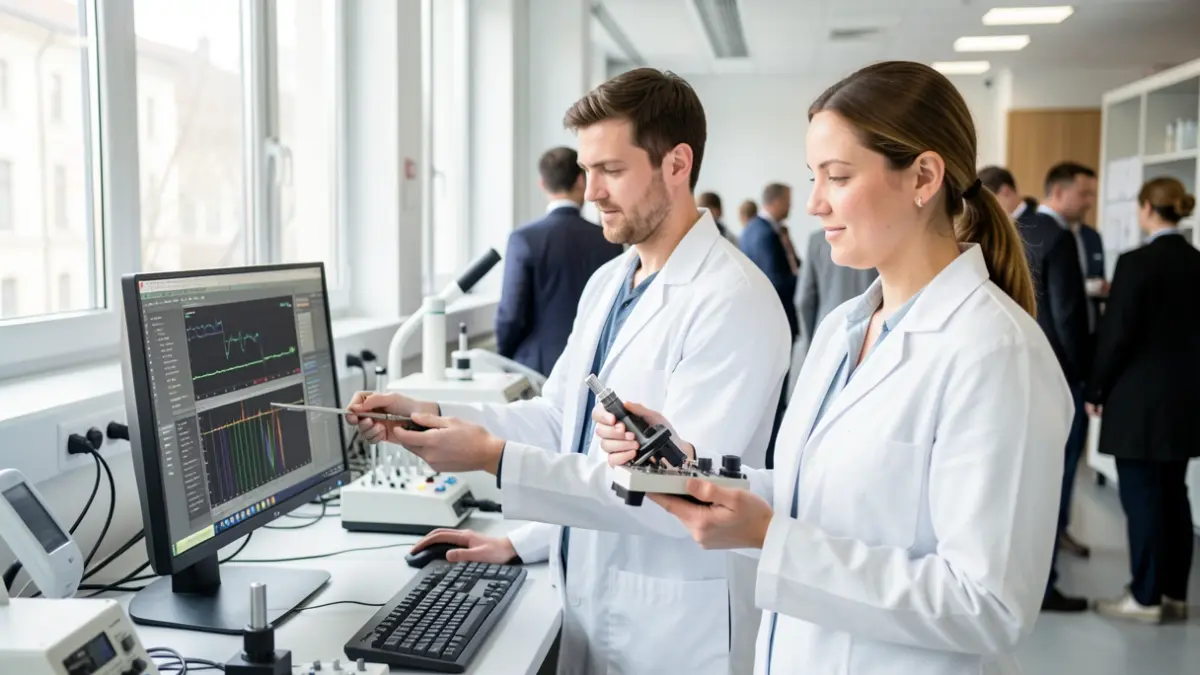
Pratik Samant and Lara Bonney, Principal Clinical Scientists at Oxford University Hospitals (OUH), have been awarded three-year grants by the National Institute for Health and Care Research’s (NIHR) Research for Patient Benefit (RfPB) Programme. This funding is specifically aimed at early career researchers and health and care professionals within the NHS.
These awards mark a significant achievement, as healthcare scientists are often underrepresented in research. Pratik and Lara are among the first healthcare scientists at OUH to receive these prestigious NIHR RfPB grants. Both expressed excitement about the opportunity to conduct research that might not be feasible under normal clinical pressures.
Lara Bonney, a Medical Physicist supporting nuclear medicine departments across OUH, highlighted the personal and professional significance of the funding. She stated, “This is the kind of research we couldn't do without that funding for my time. It gives us the opportunity to expand and press ahead with projects where we have done some initial feasibility work and believe it could have real benefits.”
Pratik Samant, a Principal Clinical Scientist in Research and Education, echoed this sentiment, noting the historical difficulty for healthcare scientists in securing research funding. He explained, “This NIHR research grant buys our time from the NHS so that our role can be back-filled, and this has been enormously helpful in allowing me to explore my research interests as a clinical scientist.”
Pratik's project focuses on radiotherapy, specifically addressing situations where a patient's cancer returns after initial treatment. He is developing software to more accurately calculate radiation doses from two rounds of radiotherapy by precisely aligning CT scans. This approach aims to account for changes in a patient’s body over time, thereby improving treatment planning and reducing the risk of damaging healthy organs.
Lara's research aims to enhance the quality checks for PET/CT scanners, which are crucial for cancer care but require significant downtime for regular checks, potentially delaying patient appointments. She plans to use artificial intelligence, trained on 20,000 existing scans, to perform quality checks after each patient use. This could lead to immediate problem spotting, same-day scan repetitions, and increased patient throughput.
Associate Professor Daniel McGowan, Head of Education and Research at OUH’s Department of Medical Physics and Clinical Engineering, who co-applied for Pratik’s submission and is supporting Lara’s project, congratulated the scientists. He emphasised the importance of recognising and supporting healthcare scientists, who underpin a significant percentage of clinical diagnoses and have much to offer in research.
He also extended thanks to the patients who contributed to the development of these research proposals and will be involved throughout the projects.